Our Young Athletes’ Weekly Schedule: How We Balance Training, Recovery & Life
Coach Dad & Dr. Mom | Raising Whole Athletes

If you’re raising a young athlete, you’ve probably looked at their weekly schedule and wondered:
Are we doing too much? Are we doing enough? And where does recovery fit?
Between practices, games, skills training, conditioning, school, and everything else, a young athlete’s week can fill up quickly.
And if your athlete loves their sport, they may be asking for more, not less.
Our boys love basketball. If it were completely up to them, they would probably choose to play every day.
But we want them to keep loving their sport.
So instead of simply adding more training whenever we have an open day, we sat down with our boys and created their weekly schedule together.
The result is a routine that gives them opportunities to work hard and develop as athletes while intentionally making room for recovery and life outside of basketball.
Here’s what our current week looks like.
Our Young Athletes’ Weekly Schedule
Day | Focus |
Monday | Skills Training + Conditioning |
Tuesday | Recovery |
Wednesday | Team Practice |
Thursday | Recovery |
Friday | Non-Sport Activity |
Saturday | Skills Training + Conditioning |
Sunday | Team Practice |
This isn't a perfect schedule, and it isn't a recommendation that every young athlete should follow the same routine. Our boys are currently in pre-season so they are practicing more with their team, off season and in season schedules look differently.
Think of it as an example of how our family is trying to balance training, practice, recovery, and life outside of sports.
Why We Created the Schedule With Our Boys
One of the most important parts of our schedule isn't actually what happens Monday through Sunday.
It's how we created it.
We included our boys in the conversation.
We want them to learn that being an athlete isn't only about showing up to practice. It's also about learning how to train, recover, listen to their bodies, manage their time, and make choices that support their goals.
And yes, they would choose more basketball.
That's a good thing.
We want them to be excited about their sport.
But as parents, we're also responsible for looking at the bigger picture.
We don't want every open afternoon to automatically become another workout, practice, or skills session.
Sometimes protecting an athlete's excitement for their sport means giving them space away from it too.
Monday: Skills Training + Conditioning
Monday is one of our focused training days.
This is an opportunity to work on individual basketball skills and conditioning outside of team practice.
Team practices have their own purpose. Coaches are preparing an entire group of athletes, working on plays, team concepts, skills, and competition.
Individual training allows our boys to spend more focused time developing themselves as athletes.
But the goal isn't simply to make them tired.
Training should have a purpose.
Tuesday: Recovery
Tuesday is intentionally a recovery day.
And that's an important word: intentionally.
We don't view recovery as a day when we're failing to train.
Recovery is part of the plan.
And recovery doesn't necessarily mean doing nothing.
These are great days for our boys to work on some of the other pieces of being an athlete that don't require another workout.
They might:
Watch a motivational video
Watch film from a game or practice
Journal about their goals, progress, or mindset
Use a massage gun
Soak their feet
Do other simple self-care activities
We also use these days to teach our boys something that may seem small now but can matter later: how to take care of their own bodies.
That includes the little things.
Cut your nails. Clean your ears. Take care of your feet. Pay attention to hygiene. Learn how to use a foam roller or massage gun appropriately. Notice when your body feels tired or sore.
None of those things are flashy.
But we're trying to teach them that taking care of themselves is part of being an athlete too.
As they get older, Mom and Dad shouldn't have to manage every part of their health and recovery for them.
We want them gradually learning:
This is my body, and I have a responsibility to take care of it.
That's a skill they'll need long after youth sports are over.
Wednesday: Team Practice
Wednesday is basketball practice.
That is the training for the day.
We don't automatically feel the need to add another workout before or after practice just because they could technically fit one in.
More isn't always better.
When it's time for practice, we want them all in.
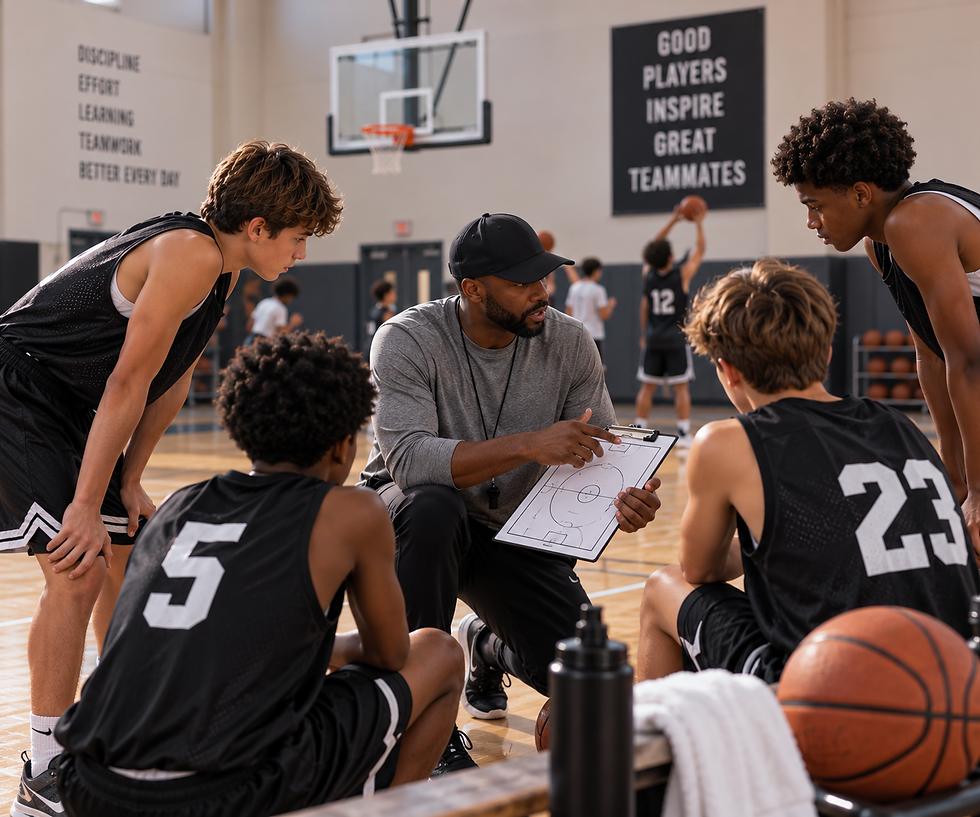
Ready to work.
Ready to listen.
Ready to learn.
And still excited to be there.
Thursday: Recovery
Thursday gives them another break from structured training.
Just like Tuesday, this doesn't have to be an empty day.
It can be a day for physical recovery, self-care, film, mindset work, journaling, or simply enjoying some downtime.
It's also an opportunity for us to pay attention to how they're doing.
Are they sore?
How are they sleeping?
How is their energy?
Are they excited about the next training session?
Are they mentally tired?
What's happening at school?
And, increasingly, we want them learning to answer those questions too.
A schedule gives us structure, but it shouldn't stop us from responding to the athlete standing in front of us.
Sometimes the schedule needs to change.
Friday: Life Outside of Their Sport
Friday is intentionally different.
It's not a basketball day.
We want our boys to experience activities that have nothing to do with becoming better basketball players.
Maybe they go skating.
Maybe they play outside.
Maybe we do something as a family.
Maybe they try another activity.
Maybe they simply enjoy having a Friday that isn't structured around basketball.
Because before they're basketball players, they're kids.
Their entire identity shouldn't be tied to how well they perform in a sport.
Sports can be an important part of childhood without becoming all of childhood.
Saturday: Skills Training + Conditioning
After Friday's break from basketball, Saturday is another focused training day.
This is a day when we can work on individual skills, conditioning, and overall athletic development.
And this is where we see one of the benefits of intentionally creating space throughout the week.
When it's time to train, they're all in.
We aren't trying to convince them to get another workout done.
They want to be there.
They want to improve.
They still have that excitement.
That's something we want to protect.
Sunday: Team Practice
Sunday brings us back to basketball practice.
Then another week begins.
Of course, real life doesn't always follow the schedule perfectly.
Games, tournaments, school events, family plans, travel, illness, soreness, and other commitments can change things.
That's why we treat this schedule as a framework, not a rulebook.
Don't Just Copy Our Schedule... Build One With Your Athlete
If our schedule works as a starting point for your family, copy it.
But don't stop there.
Sit down with your athlete.
Look at everything already required of them, practices, games, school, homework, family commitments, and other activities.
Then look at where additional training actually makes sense.

And don't forget to ask:
Where is recovery?
Where is life outside of their sport?
How does my athlete feel about this schedule?
Are we leaving room for them to still want more?
And consider something else:
What can they begin taking ownership of themselves?
Maybe that's remembering their water bottle. Maybe it's getting their gear ready. Maybe it's foam rolling after a hard week, taking care of their feet, watching film, or recognizing when their body needs a break.
These small responsibilities can help young athletes gradually learn how to care for themselves instead of always waiting for a parent or coach to tell them what to do.
Your athlete's schedule may look completely different from ours.
That's okay.
The goal isn't to create the perfect seven-day schedule.
The goal is to create a rhythm that works for your athlete and your family.
Subscribe to our Monthly Newsletter
Join the RWA newsletter for:
• Free resources
• Monthly challenges
• Helpful parent tips
• Early updates on new programs, launches & special offers
Stay in the loop with Raising Whole Athletes.
We Want Them to Keep Loving Their Sport
We want our boys to improve.
We want them to work hard.
We want them to develop their skills, become stronger athletes, learn from their coaches, and pursue the goals they have for themselves.
But we also want something else:
We want them to keep loving basketball.
So yes, sometimes they want more.
And sometimes we intentionally choose not to give them more.
Because we aren't trying to see how much training we can squeeze into seven days.
We're trying to raise athletes who understand that training hard is only one piece of taking care of themselves.
Learning to recover, reflect, take care of their bodies, enjoy interests outside of sports, and recognize what they need matters too.
We want them to train well, recover well, live well ... and then show up all in when it's time to play.
That's part of what it means to us to raise a whole athlete.
Build the athlete behind the sport.
Coach Dad & Dr. Mom | Raising Whole Athletes
*A quick note: You’ll occasionally find links to products our family actually uses or recommends. If you choose to purchase through these links, we may earn a small commission at no extra cost to you. We only share products we believe help families raise healthy, resilient athletes. Thank you for supporting Raising Whole Athletes.


Comments